Where AI Forecasting Went Wrong — and What We Learned
INSIGHTS
12/21/20253 min read
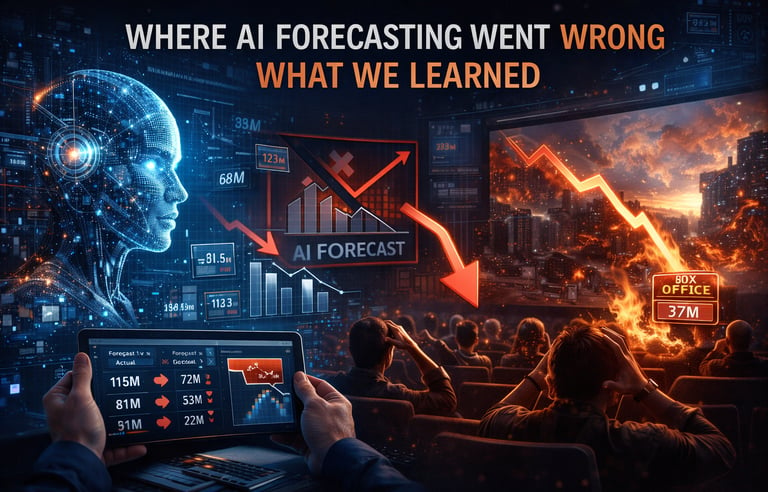
Where AI Forecasting Went Wrong — and What We Learned
Lessons From the Misses, Not Just the Hits
AI forecasting doesn’t fail quietly.
When it misses, the numbers are public, the headlines are loud, and the comparisons are immediate. That’s uncomfortable — but it’s also where the real learning happens.
At The AI Box Office, we don’t believe credibility comes from being right all the time.
It comes from understanding why something went wrong — and adjusting accordingly.
This follow-up isn’t about defending AI.
It’s about being honest with it.
Why Misses Matter More Than Hits
When AI forecasts land close, the takeaway is usually simple:
the model worked as expected.
But when forecasts miss meaningfully, something more valuable is revealed:
A blind spot
A faulty assumption
A signal we overweighted
Or a human behavior we underestimated
Those misses are where forecasting systems actually evolve.
Where AI Forecasting Most Commonly Went Wrong
Across multiple releases, genres, and release strategies, the misses tended to fall into a few consistent categories.
1. Overweighting Early Signals
AI models love clean data:
Pre-sales
Trailer engagement
Social volume
Early tracking comps
The problem?
Not all early signals convert equally.
In several cases, strong early interest:
Didn’t translate into walk-up traffic
Plateaued faster than expected
Reflected curiosity, not commitment
Lesson learned:
Early data is directionally useful — but not definitive. We now treat it as a starting point, not a conclusion.
2. Underestimating Audience Fatigue
One of the hardest things for AI to measure is emotional exhaustion.
On paper, the comps look solid:
Familiar IP
Proven genre
Recognizable talent
In reality, audiences sometimes say:
“Not this again.”
AI models built on historical performance struggled to fully account for:
Franchise saturation
Genre burnout
Diminishing novelty
Lesson learned:
Historical success does not guarantee present-day appetite. Context matters more than legacy.
3. Assuming “Normal” Drops in Abnormal Markets
Many forecasting models rely on average weekend-to-weekend drops.
But recent releases reminded us:
Audience behavior is no longer normalized
Competition stacks faster
Attention cycles are shorter
Streaming awareness changes urgency
Some films didn’t just drop — they fell off.
Lesson learned:
Volatility bands need to be wider. The idea of a “standard drop” is increasingly outdated.
4. Missing the Human Spark (or Lack of One)
AI struggles most with what can’t be quantified:
Emotional resonance
Cultural conversation
The why behind attendance
Some films:
Looked strong on paper
Had solid awareness
Yet failed to ignite passion
Others were surprised because audiences connected in ways models didn’t anticipate.
Lesson learned:
AI can measure attention — not attachment.
What We Changed Because of These Misses
Misses are only useful if they lead to better systems. Here’s how the approach evolved.
1. We Leaned Harder Into Ranges, Not Numbers
Single-point forecasts create false confidence.
We now emphasize:
Forecast bands
Volatility flags
Scenario thinking
This helps decision-makers plan for risk, not just hope.
2. We Built Context Into the Forecast, Not Just the Output
Instead of asking:
“What will this movie open to?”
We ask:
What conditions could push it high?
What factors could pull it low?
What would change the trajectory mid-run?
Forecasts are no longer static — they’re conditional.
3. We Gave Human Judgment More Weight, Not Less
Counterintuitive, but true.
When AI output conflicts with:
Exhibitor intuition
Local knowledge
Genre sentiment on the ground
That conflict becomes a signal, not something to ignore.
The goal isn’t to silence instinct — it’s to pressure-test it.
What This Means for the Industry
AI forecasting isn’t broken.
But it isn’t finished.
The biggest mistake would be pretending misses don’t matter — or worse, hiding them.
The box office is evolving faster than historical models can keep up with. That means:
Forecasting must be adaptive
Confidence must be measured
Transparency must be part of the process
AI should inform decisions — not dictate them.
Final Thought
The future of box-office forecasting isn’t about perfection.
It’s about:
Better questions
Clearer assumptions
Honest post-mortems
At The AI Box Office, we’ll keep publishing the wins — and the misses — because both are necessary.
Forecasting isn’t about being right.
It’s about being ready.